
My Development as a Future Leader

“The pessimist complains about the wind. The optimist expects it to change. The leader adjusts the sails.”

-John Maxwell

What is Leadership?

Having come across many different definitions of leadership by some of the greatest authors and managers, for what would I think leadership is, Mr. Warren Bennis (an American Scholar who is widely regarded as a pioneer in leadership studies) gave the most suitable definition–

“Leadership is a function of knowing yourself, having a vision that is well communicated, building trust among colleagues, and taking effective action to realize your own leadership potential.”

According to his definition, to be a good leader it is important to know your own strengths and weaknesses, to know what you are good at and the areas that you struggle in, in order for you to understand the effectiveness of your leadership skills to achieve your team’s objectives and goals. A well communicated vision is like an action plan that helps the team to stay on track and make progress towards the set objectives. For people to follow you, it is important for them to have trust in you, your abilities and your vision. Warren Bennis said that- “leadership is the capacity to translate vision to reality”, and for this, the leader along with his team has to take effective actions in order for the them to move closer to their goal.

My Journey as a Leader

Week 1, Seminar class for Leading in a Changing World,

The class was divided into several teams and were given a task – a Treasure Hunt!

Our objective was to go to the nearby tube station and collect objects and information in 20 minutes. Why were we doing this? We didn’t know, but the time allotted for the task was short, so without thinking much we began working. I came up with the plan, asked my team members what they knew about the place and what they thought they could do, divided the work and then we set off after deciding a meeting place and time. The task was over, and we did okay. The seminar lecturer asked us a question- Who was the leader? And to my surprise, my team said it was me.

I didn’t know that I was leading the team, it was just that sense of urgency that brought out my leadership qualities and made me do what I did.

Through out the term we were taught about different leadership theories and styles, and the theory that would fit my style of leadership would probably be Situational Leadership.

Situational Leadership

Situational leadership theory suggests that leadership style changes according to the situation, and to become a successful leader one must adapt their style according to the ability and willingness of the team or team members whom they want to lead and influence (Paul Hersey and Ken Blanchard, 1969). Situational leadership is based on combination of two behaviours- Task behaviour or Directive behaviour which involves setting goals for the team, and Relationship behaviour or Supportive behaviour which involves two-way communication with team members.
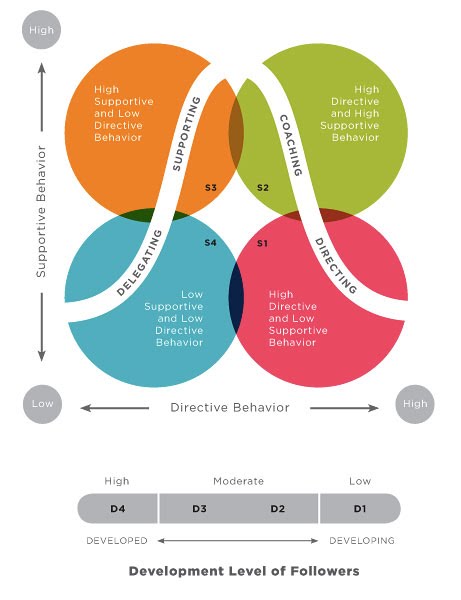
Situational Leadership Curve (Paul Hersey and Ken Blanchard)

The model designed by Blanchard and Hersey consists of four styles,

  1. Directing – Decisions are made by the leaders and communicated to the team, and the team is expected to accept them.
  2. Coaching – Leader takes the decision but considers the suggestions of his team. This involves two way communication between the leader and the team.
  3. Supporting – Here, the decision making power is in the hand of the team members, but the leader is involved in the process of making decisions.
  4. Delegating – The involvement of leader in the team is minimum and the teams are responsible for solving their problems and making decisions.

According to Blanchard and Hersey, the leadership style depends on development level of the team members.

  • A Directing leader is suited to work with team members who lack the readiness to work.
  • A Coaching leader is suited to work with a team in which the members have the willingness to work but lack the ability.
  • A Supporting leader is suited to work with a team in which the members of the team have the ability but lack the willingness to work.
  • And a Delegating leader is best suited for a team where members have both the ability and willingness to work.

Developing as a Future Leader

During the term I had the chance to be the leader at multiple occasions, we performed multiple tasks, did assignments and presentations together as a team. According to the Belbin test that we took during week 4, I found that I am an implementer- who is disciplined and reliable, but is somewhat inflexible and slow to respond to new possibilities, and the feedback that I received from my team members suggests the same – they believe I am interactive, reliable and have the willingness to lead the team, but need to be more flexible. There were multiple instances when I found it difficult to work with other people and couldn’t understand their perspectives or accept their opinions, and I understood that leadership is a skill that can be learned only through practice. I am willing to work in teams more than I ever did, and I look forward to develop myself and become a better leader in the future by applying the situational leadership theory to myself by assessing my team members’ capabilities and skills, and their motivation and willingness to work and then changing the way I lead them accordingly.

Thank you for reading my blog, please feel free to express your opinions in the comments section below.

References

Chapman, B. (2018) Situational Leadership: A key leadership skill, Leadership Excellence, 35(9), pp. 16–17 [Online] Available from <http://search.ebscohost.com/login.aspx?direct=true&AuthType=ip,sso&db=bth&AN=135231031&site=ehost-live (Accessed: 6 December 2019)> [04-12-2019]

Belbin (n.d.) The Nine Belbin Team Roles [Online] Available from <https://www.belbin.com/about/belbin-team-roles/> [04-12-2019]

Kendra Cherry (n.d.) The Situational Theory of Leadership [Online] available from <https://www.verywellmind.com/what-is-the-situational-theory-of-leadership-2795321> [04-12-2019]

STU Online (2019) What Is Situational Leadership®? How Flexibility Leads to Success [Online] Available from <https://online.stu.edu/articles/education/what-is-situational-leadership.aspx> [04-12-2019]

The Center for Leadership Studies (n.d.) The Right Leadership, at The Right Time. [Online] Available from <https://situational.com/situational-leadership/> [04-12-2019]

Change Management

”All great changes are preceded by chaos.”

– Deepak Chopra

And the chaos that we are talking about here is BREXIT!

As Brexit is just around the corner, let us see how one of the major confectionery company in UK is being affected by it.

Cadbury

In 1824, John Cadbury opened his first store selling tea, coffee, cocoa and drinking chocolate, prepared using a mortar and pestle. Experimenting with this mortar and pestle he produced a range of chocolate products and he soon established himself as one of the leading chocolate traders in Birmingham. The enterprise kept on growing, and in 1847 John Cadbury partnered with his brother Benjamin and together they started trading as Cadbury Brothers of Birmingham. Today, Cadbury is the largest confectionery company in the UK with a market share of 29% and has net revenues of more than $9.8 billion as of 2017 (Cadbury 2019).

The 200-year-old chocolate enterprise is now faced with something it hasn’t seen before – BREXIT!

Brexit

On Thursday 23 June 2016, a public referendum was held to decide whether UK should stay or leave the EU. More than 30 million people voted, and Leave won with a 52% vote.

So why hasn’t Brexit happened yet? UK was originally supposed to leave on 29 March 2019- two years after article 50 was triggered- but was delayed as MPs rejected the Brexit deal, pushing the deadline to 31 October and now to 31 January (BBC 2019).

Brexit’s effect on Cadbury and What Can be Done to Ensure a Smooth Brexit?

As Brexit is approaching, Cadbury is stockpiling chocolates and ingredients in case of a no-deal, Mondelez Europe’s president Hugh Weber told The Times of London Newspaper.

The company has a contingency plan for a hard Brexit and is preparing by stocking higher levels of ingredients and finished products, but the shelf life of these products is not very high, and the plan might not work for the long run.

According to Huffington post, after Brexit, tariffs on chocolate could go as high as 30 percent, which means the prices for customers will increase. The absence of hard borders in Europe allowed for an integrated supply chain and keep costs low. High prices might result in lower demands, so better warehousing for chocolates would be necessary considering their shelf life.

In case of a no-deal, Cadbury must arrange work permits for their EU employees. Employee turnover might increase so new employees must be recruited, and better training facilities would be required.

New agreements will be made with EU countries and the organisation will have to change the way it trades with EU because the free flow in the supply chain will be disrupted.

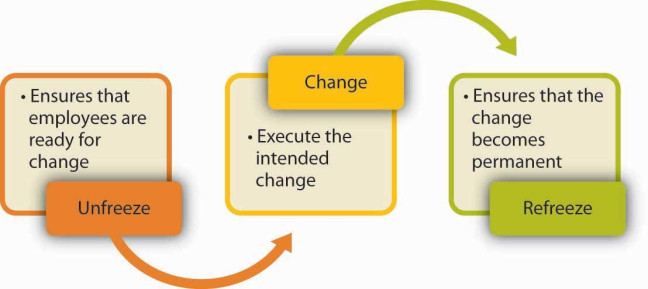
The required changes can be achieved through Lewin’s 3 step model of change.

The Change Process

Lewin’s 3 Stage Model

According to Lewin, successful change can be planned and requires unfreezing the status quo, changing to a new state, and refreezing to make the change permanent.

Unfreeze

According to Lewin, this step involves changing the present behaviors and attitudes of people in an organisation. This process takes into account the threats that the change presents to people, and the need to motivate people to accept change.

Cadbury has to start by making employees aware of the implications of Brexit and how it is affecting their organisation.

Employees need to understand why the changes are necessary and how would the change benefit them in order for them to accept it.

Change

This is the stage where the change is actually implemented. Effective communication and time is required in this stage because it is important for people to understand why change is necessary for it to be successful.

Retention of skilled employees will be important, and for this, Cadbury will have to acquire work permits for the EU national employees.

New staff will have to be recruited and trained for which facilities must be set up and budgeting must be done.

New cost management and inventory management plans must be developed to maintain stocks of ingredients and their shelf life must be monitored.

Refreeze

After the change has taken place and people have accepted the change, it is important for the organisation to again gain the equilibrium or “refreeze”.

Cadbury has to closely monitor the changes and ensure that the employees are satisfied with the changes and are motivated to work with them.

As the situation changes, it might become important to form new objectives and again revise the changes accordingly.

An organisation needs time to adapt to the new changes to gain back the equilibrium and the managers at Cadbury have to be patient and observant for this process to happen smoothly.

References

Cadbury (2019) The Story Of Cadbury [Online] available from <https://www.cadbury.com.au/About-Cadbury/The-Story-of-Cadbury.aspx> [02-12-2019]

BBC (2019) Brexit: All you need to know about the UK leaving the EU [Online] available from <https://www.bbc.co.uk/news/uk-politics-32810887> [02-12-2019]

UK Gov (2019) Brexit [online] available from <https://www.gov.uk/brexit> [02-12-2019]

Carly Ledbetter (2017) Here’s How Brexit Is Going To Affect Your Cadbury Chocolate [Online] available from <https://www.huffingtonpost.co.uk/entry/brexit-cadbury-chocolate_n_58dbd126e4b01ca7b428e956?guce_referrer=aHR0cHM6Ly9jb25zZW50LnlhaG9vLmNvbS9jb2xsZWN0Q29uc2VudD9zZXNzaW9uSWQ9M19jYy1zZXNzaW9uXzZlYzM5N2FlLWI5YWItNDk3MS05NzZmLTNlYTgyNGE2YjM0ZCZsYW5nPWVuLXVzJmlubGluZT1mYWxzZQ&guce_referrer_sig=AQAAAHwCcIeMUZeDaDlD_qVtQrFrNWwMz_uaLVhcu-lesgHX7n5O9iH5SPkO0q9TKVp5VMZPBpWGaINGp_YBVxtxnKm40j7I3TKjorDtzDQWIsf7w9j95fdICCswGFV-zjayJFeqemD7Tyv-5kmtUsONN12OFq6Mz8buGqPcZgQysqdO> [02-12-2019]

The Washington Post (2018) Brexit might be so bad that Cadbury is stockpiling chocolate just in case [Online] <https://www.washingtonpost.com/world/2018/09/11/brexit-might-be-so-bad-that-cadburys-is-stockpiling-chocolate-just-case/> [02-12-2019]

Independent (2018) Cadbury owner Mondelez stockpiling chocolate and biscuits to prepare for no-deal Brexit [Online] <https://www.independent.co.uk/news/business/news/cadburys-no-deal-brexit-chocolate-stockpiles-biscuits-mondelez-a8532276.html> [02-12-2019]

The Guardian (2017) Cadbury says chocolate could get smaller after Brexit [Online] <https://www.theguardian.com/business/2017/mar/24/cadbury-warns-chocolate-could-get-smaller-after-brexit> [02-12-2019]

Rebeca Zambrano (2018) The European Union, Brexit, and Chocolate [Online] <https://sites.utexas.edu/longhornglobalbiznet/the-european-union-brexit-and-chocolate/> [02-12-2019]

Cadbury UK (n.d.) Fact Sheet Chocolate Manufacturing [Online] <https://www.cadburyworld.co.uk/schoolandgroups/~/media/cadburyworld/en/files/pdf/factsheet-chocolate-manufacture> [02-12-2019]

HM Revenue and Customs (2019) Value of sugar confectionery and chocolate exports from the United Kingdom from 2003 to 2018, split by EU and non-EU trade (in 1,000 GBP). [Online] <https://www.statista.com/statistics/307380/uk-united-kingdom-confectionery-chocolate-exports-value-annually/> [02-12-2019]

Anthony Myers (2019) Mondelēz’s strong UK sales prepares company for a no-deal Brexit [Online] <https://www.confectionerynews.com/Article/2019/08/01/Mondelez-s-strong-UK-sales-prepares-company-for-a-no-deal-Brexit> [02-12-2019]

Design a site like this with WordPress.com
Get started